

Hours before a planned protest march towards the Indian High Commission in Dhaka, the Ministry of External Affairs (MEA) summoned Bangladesh’s High Commissioner to India in New Delhi on Wednesday to convey India’s serious concerns regarding the deteriorating security situation in the Bangladeshi capital. The diplomatic engagement highlighted activities of certain extremist elements who have reportedly announced plans to create a tense security environment around the Indian High Commission. The action came as tensions rose due to anti-India rhetoric and ongoing unrest in Dhaka.
The MEA summoned Bangladesh High Commissioner Riaz Hamidullah to express India’s strong apprehension about the situation. The ministry pointed out that some extremist groups had publicly declared intentions to disturb security near the Indian mission, posing risks to personnel and diplomatic property. The move was described as necessary to ensure that India’s missions in Bangladesh remained safe and secure in accordance with international diplomatic norms.
The MEA’s concerns were linked to inflammatory statements made by National Citizen Party (NCP) leader Hasnat Abdullah, who reportedly threatened that, if Bangladesh were “destabilised,” India’s northeastern states would be isolated and provided refuge to separatist elements from the region. Abdullah’s remarks drew sharp criticism from Indian authorities, who viewed the statements as an attempt to create unrest in the vicinity of Indian diplomatic premises in Dhaka.
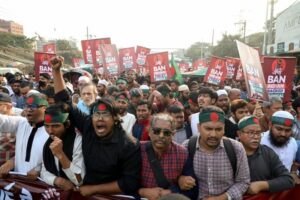
On Wednesday afternoon, Bangladesh police intervened to stop a group of protesters, operating under the banner of “July Oikya,” from marching towards the Indian High Commission. The demonstrators reportedly demanded the return of ousted Bangladesh Prime Minister Sheikh Hasina and other political figures who had fled to India following last year’s July uprising. The incident underscored concerns regarding law and order near the diplomatic mission and the potential threats posed by extremist actors.
In a statement, the MEA said, “The Bangladesh High Commissioner to India, Riaz Hamidullah, was summoned and apprised of India’s strong concerns at the deteriorating security environment in Bangladesh. His attention was drawn, in particular, to activities of some extremist elements who have announced plans to create a security situation around the Indian Mission in Dhaka.”
The statement further rejected claims made by extremist groups regarding recent events in Bangladesh. It said, “India completely rejects the false narrative sought to be created by extremist elements regarding certain recent incidents in Bangladesh. It is unfortunate that the interim government has neither conducted a thorough investigation nor shared meaningful evidence with India regarding these incidents.”
India urged the interim Bangladeshi administration to ensure the safety of foreign missions and diplomatic posts in line with its international obligations. Officials emphasized that India maintained close and friendly relations with the people of Bangladesh, rooted in the country’s liberation struggle and strengthened through developmental initiatives and people-to-people exchanges. The MEA highlighted that India supported peace, stability, and credible elections in Bangladesh and called for an environment conducive to free, fair, and inclusive electoral processes.
Amid rising tensions, the relationship between India and Bangladesh remained anchored in shared economic and strategic interests. The MEA reiterated India’s position in favor of stability in Bangladesh and emphasized continued support for democratic processes. It stressed the importance of upholding the security of Indian missions and personnel, warning that any threats to diplomatic establishments would be taken seriously.

Earlier on Wednesday, Bangladesh celebrated Victory Day with cultural events hosted at its embassy in New Delhi. High Commissioner Riaz Hamidullah highlighted Bangladesh’s commitment to addressing the aspirations of its people, particularly the younger generation. He also stressed that Bangladesh and India shared a mutually beneficial relationship, focusing on regional peace, prosperity, and security. “We believe our relationship with India is in our shared interest. We have mutual interdependence, and cooperation between our nations benefits our people,” he said.
In parallel, External Affairs Minister S. Jaishankar extended greetings to Bangladesh, addressing Foreign Affairs Adviser Mohammad Touhid Hossain, the interim government, and the people of Bangladesh on Bijoy Dibosh through a post on X. The message emphasized goodwill and continued cooperation between the two neighboring countries.
In response to the security concerns and ongoing unrest, India temporarily closed its Visa Application Centre (IVAC) in Dhaka. The centre, located at Jamuna Future Park, is the main facility handling all Indian visa services in the capital. The closure was announced on Wednesday, with the IVAC stating, “In view of the ongoing security situation, we wish to bring to your kind notice that IVAC JFP Dhaka will be closed at 2 pm today.” The decision was taken to safeguard staff and applicants amid heightened tensions in the city.
The temporary closure of the visa centre highlighted the seriousness of the situation on the ground in Dhaka. Indian authorities underscored that the safety of diplomatic staff and visitors remained a top priority, particularly in light of threats posed by extremist elements and protests targeting Indian interests.
Security forces in Dhaka were placed on high alert, and preventive measures were implemented to ensure that protests remained contained. Authorities maintained vigilance around the Indian High Commission and other diplomatic missions. Efforts were made to prevent escalation and mitigate risks posed by large gatherings or extremist activities.
The diplomatic engagement and preventive measures reflect India’s proactive approach in ensuring the protection of its missions and personnel in Bangladesh. Officials noted that consistent dialogue with Bangladeshi authorities was essential to maintain security and uphold international norms governing the safety of diplomatic entities.
The situation in Dhaka also brought attention to ongoing political tensions in Bangladesh, with demonstrations calling for the return of political leaders who fled the country during last year’s unrest. Indian authorities emphasized that while they respected Bangladesh’s internal political dynamics, the safety of Indian missions and citizens in Bangladesh remained non-negotiable.
MEA officials highlighted that extremist rhetoric and planned disruptive activities could jeopardize regional stability. They stressed that cooperation between India and Bangladesh was crucial to prevent threats to security and maintain peaceful relations. Authorities urged Bangladeshi officials to take immediate and effective action to avert escalation around diplomatic establishments.
The closure of IVAC in Dhaka and the diplomatic engagement with Bangladesh’s High Commissioner indicate the seriousness with which India is approaching the matter. Both countries remain committed to long-term cooperation in trade, security, and cultural exchange, but authorities emphasized that safeguarding personnel and missions remains a priority.
India’s efforts to address the security concerns in Dhaka form part of broader diplomatic measures to maintain stability in South Asia. Officials reaffirmed that the bilateral relationship with Bangladesh is rooted in shared history, mutual respect, and strategic interests. At the same time, India conveyed its expectation that the interim Bangladeshi government would act responsibly to prevent any threats to Indian missions or personnel.
Authorities in both countries continue to monitor the situation closely. While protests and extremist threats present immediate challenges, India’s engagement with Bangladesh reflects its focus on dialogue, coordination, and preventive diplomacy. Steps taken by the MEA, including summoning the High Commissioner and temporarily closing the IVAC, aim to ensure that diplomatic operations remain secure, even as political unrest unfolds in Dhaka.
Indian officials reiterated their commitment to supporting peaceful and democratic processes in Bangladesh. They emphasized that protecting Indian citizens and missions, ensuring the safety of diplomatic staff, and maintaining stable bilateral relations were of utmost importance amid the current unrest.